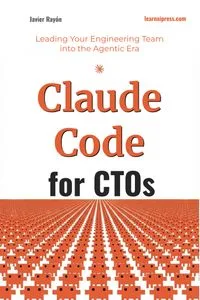
Claude Code for CTOs
by Javier Rayon
Updated October 2026
Leading your Engineering Team into the Agentic Era
30 $ (eBook) / 40 $ (paper)
5.0 out of 5 stars · 4 ratings
Synopsis
Updated June 2026: Opus 4.8 and Dynamic Workflows included
Your engineers are already using AI. Now lead the rollout — or watch it happen to you.
Every CTO, VP of Engineering, and tech lead faces the same questions in 2026: How do I introduce Claude Code, Copilot, or Cursor across my team without breaking workflows? What does this really cost at scale? How do I measure ROI without gaming the metrics? How do I govern security when an agent is reading production code? When does an agent get to touch production, and under what controls?
Tutorials do not answer these questions. Vendor decks do not answer these questions. Claude Code for CTOs does.
After the success of Claude Code: Getting Started and Claude Code Advanced, the author brings together in this book all his experience as Chief AI Officer, working with a product and engineering team of more than 100 people at Sesame HR—one of Europe’s fastest-growing scale-ups, awarded by Chargebee as an AI Pioneer and recognized as one of the companies with the fastest adoption of AI across its processes.
This is the first complete playbook for adopting AI-powered development in a real engineering organization — 22 chapters, 5 appendices, ~52,000 words of frameworks, decision matrices, and budget models distilled from leading the agentic transition of a 40-engineer team across a two-million-line backend. No hype. No vendor marketing. Only what actually works when 50 developers try to use the same tool the same day.
What you will learn
✅ The adoption playbook: Pilot, rollout, and scale — from 3 developers to 100 — with the exact conversations, checklists, and milestones that get buy-in instead of backlash.
✅ The business case, with real numbers: API vs. Max pricing, break-even points, ROI models your CFO will accept, and where the vendor data is misleading.
✅ The vibecoded-app problem: What to do when a non-engineer ships a Lovable prototype and the CEO wants it in production by Friday.
✅ Security, compliance, and governance: What your CISO actually needs to approve, how to handle data retention, and the policies that keep auditors off your back.
✅ The harness — your organization's control layer: Memory, permissions, hooks, and isolation. The four concentric layers that turn "we are experimenting with AI" into "we have AI-powered development under organizational control."
✅ CLAUDE.md for teams: Turn this single file into organizational memory — architecture, conventions, and guardrails that every agent inherits automatically.
✅ Large brownfield codebases: A five-phase framework to audit, onboard, and modernize legacy code — the 400,000-line monolith nobody fully understands anymore.
✅ Context management at scale: The one skill that separates teams that get consistent value from teams that get frustration.
✅ Parallelization and multi-repo workflows: Run 3–5 agents concurrently across microservices without losing control.
✅ Measuring impact without gaming metrics: Which numbers matter, which ones lie, and the monthly survey that reveals adoption health in one question.
Inside the book — 22 chapters across two complete blocks
Block I — The People Side (Chapters 1–10) — the half you bring to your leadership meeting.
The CTO's Reality — solo founder, player-coach, scaling leader.
The Agentic Shift — why this is not autocomplete.
The Landscape — Claude Code, Copilot, Cursor, honestly compared.
The Business Case — what to tell your CFO.
Work Methodology — the rituals that separate teams that succeed from teams that just installed a tool.
Onboarding Your Team — the adoption playbook without mandates.
Measuring Impact — metrics that survive scrutiny.
The Vibecoded App Problem — from prototype euphoria to production reality.
Security, Compliance, and Governance — what your CISO needs to hear.
Scaling Adoption — from pilot team to entire organization.
Block II — The Technical Side (Chapters 11–22) — for the CTO who still reads pull requests.
The Harness — memory, permissions, hooks, isolation.
CLAUDE.md — your team's source of truth as a living document.
Legacy Codebases — auditing and modernizing 500K-line systems.
New Projects — three approaches for three contexts.
Context Management — the technique that compounds at team scale.
Parallelization — running multiple coordinated sessions safely.
Multi-Repo Setup — workspace topology across backend, frontend, mobile, API.
Multi-Repo Development — coordinating changes across ecosystems.
Deploying Claude Code — CLI vs. API vs. SDK vs. Managed Agents.
Automation and Internal Tooling — embedding Claude Code into CI/CD.
Designing Agentic Products — pushing back on bad agentic features.
The MCP-First Future — headless software and tool-use ecosystems.
Five appendices close the book: A) Adoption Checklist · B) CLAUDE.md Templates · C) Tool Comparison Matrix · D) Glossary · E) Curated Resources.
This book is for you if
👉 You are a CTO, VP of Engineering, engineering manager, or tech lead responsible for how your team builds software — whether you manage 5 engineers or 100.
👉 You know what Claude Code is and what it does — and you want frameworks, not tutorials.
👉 You need to make adoption decisions that survive your board, your CFO, your CISO, and your most skeptical senior engineer.
👉 You prefer opinionated advice with trade-offs explained over "it depends" consulting-speak.
Part of the learnaipress.com Claude Code series
If you or your team need the fundamentals, start with Getting Started with Claude Code. For advanced individual techniques, see Claude Code: Advanced Tips for Power Users. This book picks up where those end and asks the question neither of them asks: what happens when 50 developers do this at the same time?
Stop reading vendor decks. Start leading the transition. Your engineers are already experimenting. Your competitors are already rolling out. The only variable left is whether you drive the change or react to it.
Amazon reviews
5.0 out of 5 · 4 ratings on Amazon · See on Amazon ↗
-
5.0 out of 5 stars
Practical down to earth guide to implementing Claude Code
I enjoyed the book and recommended it to several of my clients. It looks to be a very practical guide, although I'm more on the AI governance side than the AI coding side. Jim Craig, AAISM
Teamchaos · 2026-06-04
Review on Amazon.com ↗
Book Details
- Pages
- 323
- Published
- 2026
- ISBN
- 979-8258232779
- Language
- English
Continue the series
-
Getting Started with Claude Code
Claude Code · 1
-
Claude Code Advanced
Claude Code · 2 Resources
-
Claude Code Avançado: Multiplique sua produtividade e entregue código de mais qualidade
Engineering Português
-
Codex Advanced: Agentic Engineering with OpenAI Codex
Engineering


